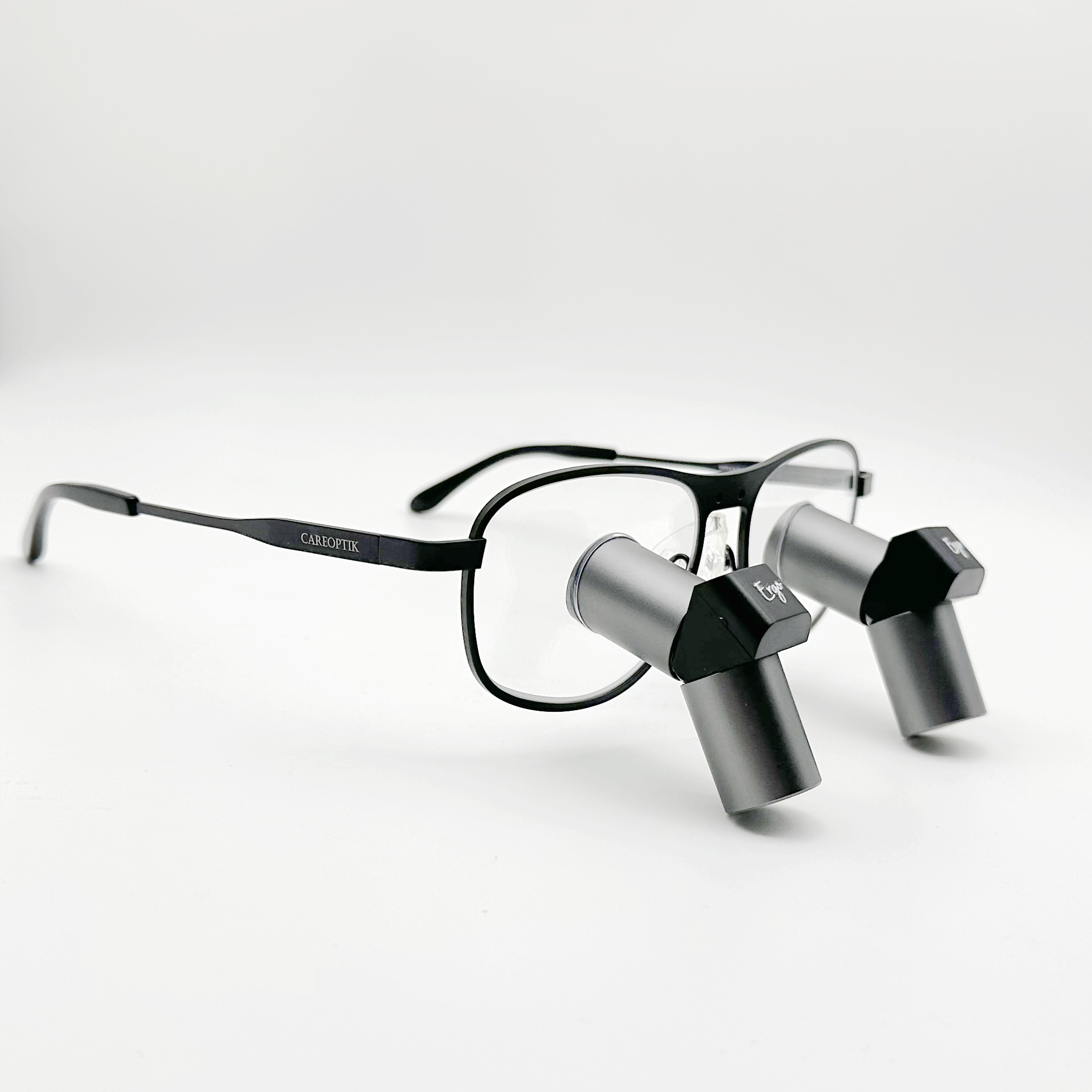

USD

The cable is rarely the first thing you notice. It's the moment it catches on the chair arm as you turn to pick up an instrument. Or the small tug that shifts the beam a few degrees off your line of sight when you lean in. Most clinicians work around it without thinking about it, the way you work around a door that sticks.
The CHL-CX02 is our cordless answer to that. It's a medical LED headlight built into a pair of TTL Galilean loupes, with the battery pack sitting on top of the frame instead of in a pocket or on a belt. No lead running down your back, nothing to clip, nothing to unplug when you stand up.
This isn't a spec sheet. It's a plain account of what's in the box, where a cable-free light genuinely helps, and the two or three situations where we'd tell you to buy something else.

Let's clear up the naming, because it causes more confusion than it should. People search for this kit under a dozen names — cordless surgical headlight, wireless medical headlamp, dental loupe light, loupes with built-in light — but it's one product. "Cordless medical lights CHL-CX02" is a lighting system supplied as a complete loupes kit. It is not a standalone headlight you can clip onto your own glasses, and it isn't a headband lamp.
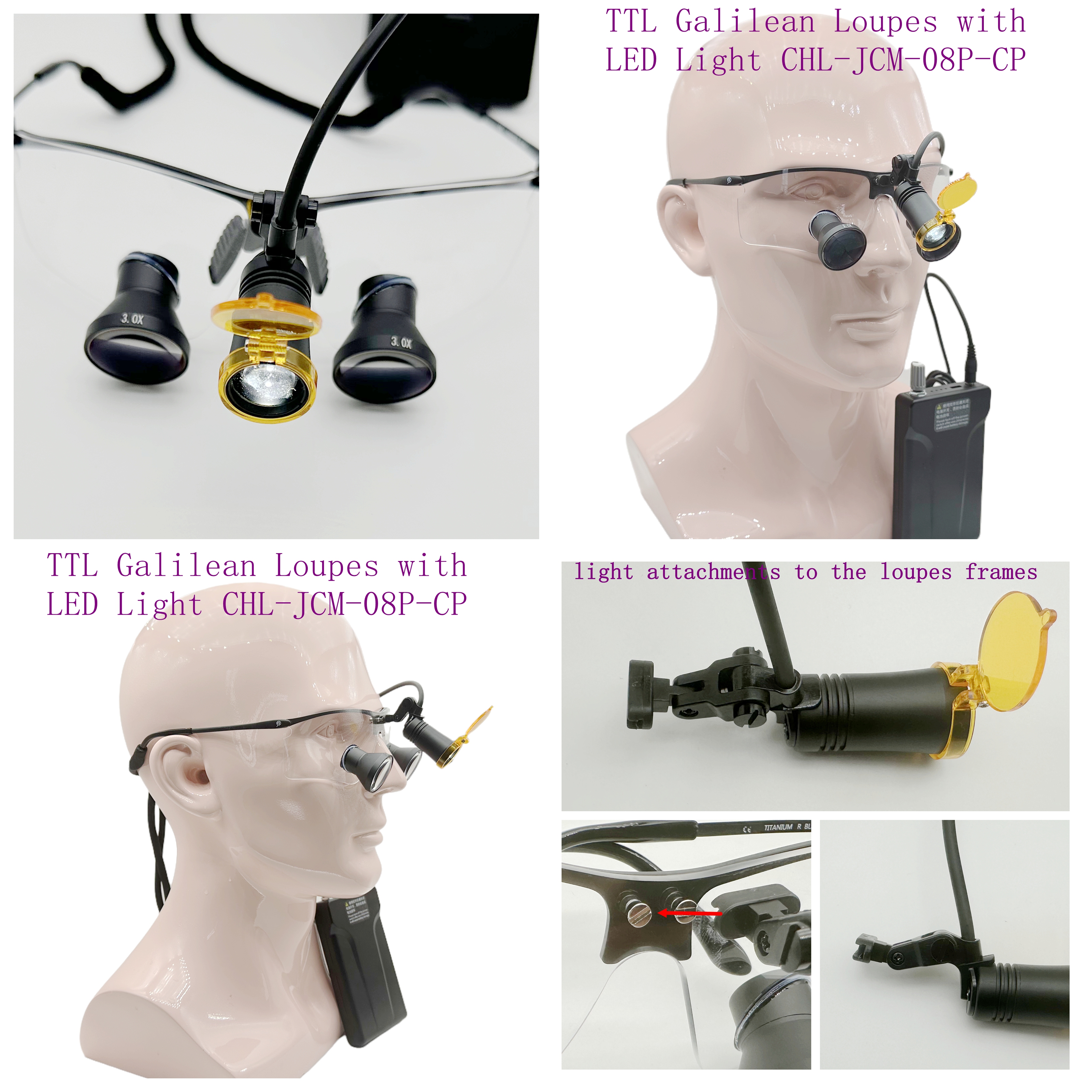
The light sits on the frame of a TTL (through-the-lens) Galilean loupe, centred between the two telescopes, on an adjustable joint. That joint matters more than it sounds. You tilt the beam down into the field you're working in, then leave it alone. Set it once for your working distance and it stays put.
The battery module sits across the top of the frame. Under it, a short arm carries the LED head, with a gold-coloured bezel and a small amber filter that flips down over the lens. In the photos on our site you'll see 3.5X marked on the telescope barrels. That's the magnification of the set we photographed, not a fixed value for every order — magnification and working distance are chosen when the loupes are made.
If you only need light and no magnification, this is the wrong product. A simple headlight will do the job for less money. We'd rather say that here than have you find out after unboxing.
Open the box and the layout tells you most of the story.
| In the box | What it's for |
|---|---|
| TTL Galilean loupes with mounted LED headlight | The working setup |
| 3 rechargeable battery packs | One in use, the others charged or charging |
| Two-slot charging dock | Charges two packs at once |
| Power adapter and USB cable | Feeds the dock |
| Amber flip-down filter | For composite work, see below |

Three batteries and a two-slot dock is a deliberate arrangement, not a spare-part accident. Two packs can sit on the dock while the third is on the frame. When you come back from a long procedure, you swap rather than wait. Clinics running back-to-back appointments tend to care about this more than any headline runtime figure.
Here's the trade-off: cordless means you own a charging habit. There is no wall cable to fall back on mid-procedure. Ask us for the current runtime and charge-time figures before you plan a clinic day around them. They depend on the brightness setting, and one optimistic number in a blog post wouldn't help anybody.
The packs show a power symbol and a brightness symbol, so on/off and light level are handled at the pack itself. That's a small reach to the top of the frame. Worth trying if you're used to a foot switch or a control on the belt.

Dental chairs are the obvious one. You twist between the patient, the tray and the cart dozens of times an hour, and a cable has a way of finding the one thing it can hook onto. Removing it doesn't make the dentistry better. It just removes a small, repeated interruption.
Hair transplant sessions are a different reason: long, head-down work where you shift position constantly and don't want to re-align a beam every time you move. Veterinary work has its own version of the problem. Patients don't hold still, and anything hanging off the operator is something a dog can catch.
Mobile clinics and outreach days get mentioned less often, though they're probably the clearest case. When there isn't a reliable socket nearby, a charged pack in the case is the whole power plan.
What we'd push back on is the idea that cordless is simply better. If you work at one fixed operating position with good overhead lighting, the CHL-CX02 solves a problem you may not have. Honest answer: buy it for mobility, not for the adjective.

Dentists will recognise this immediately. Light-cured composites don't wait politely — strong blue-rich light in the operatory can start the cure before you're ready. An amber filter over the headlight cuts that part of the spectrum while you place and shape the material, then flips back up when you want full white light again.
Ours is a small hinged flap on the headlight bezel. Fingertip down, fingertip up. No caps to lose, nothing to screw on. If you do a lot of anterior composite work you'll use it daily; if you don't, you'll forget it's there. Either is fine.
Worth saying plainly: the filter changes the colour of the light, not the brightness. It isn't a substitute for proper curing protection or shielding. It's one convenient control among several.

Putting the battery on the frame puts the mass high and central, directly over your nose rather than off to one side. That's a choice. Some people prefer it to a belt pack that tugs; others notice it in the first week and then stop noticing it. Fit matters more than any spec here. The frame has to sit right on your nose and ears before you add anything to the top of it.
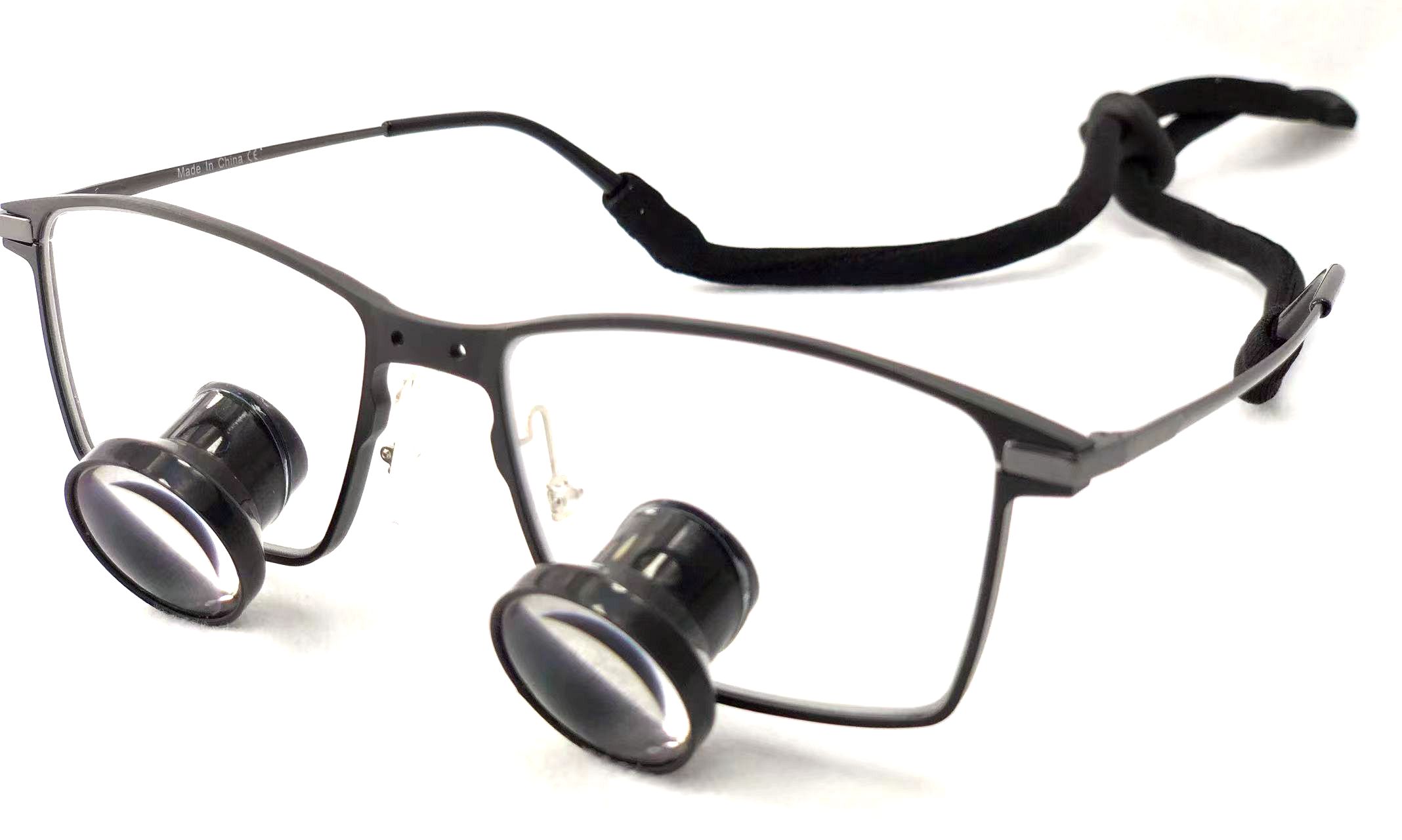
TTL stands for through-the-lens: the telescope barrels are set into the lens at your interpupillary distance when the loupes are made. They don't fold away. The headlight is fixed to the frame bridge, not to the telescope arms, so beam alignment belongs to the frame and stays consistent with how you hold your head.
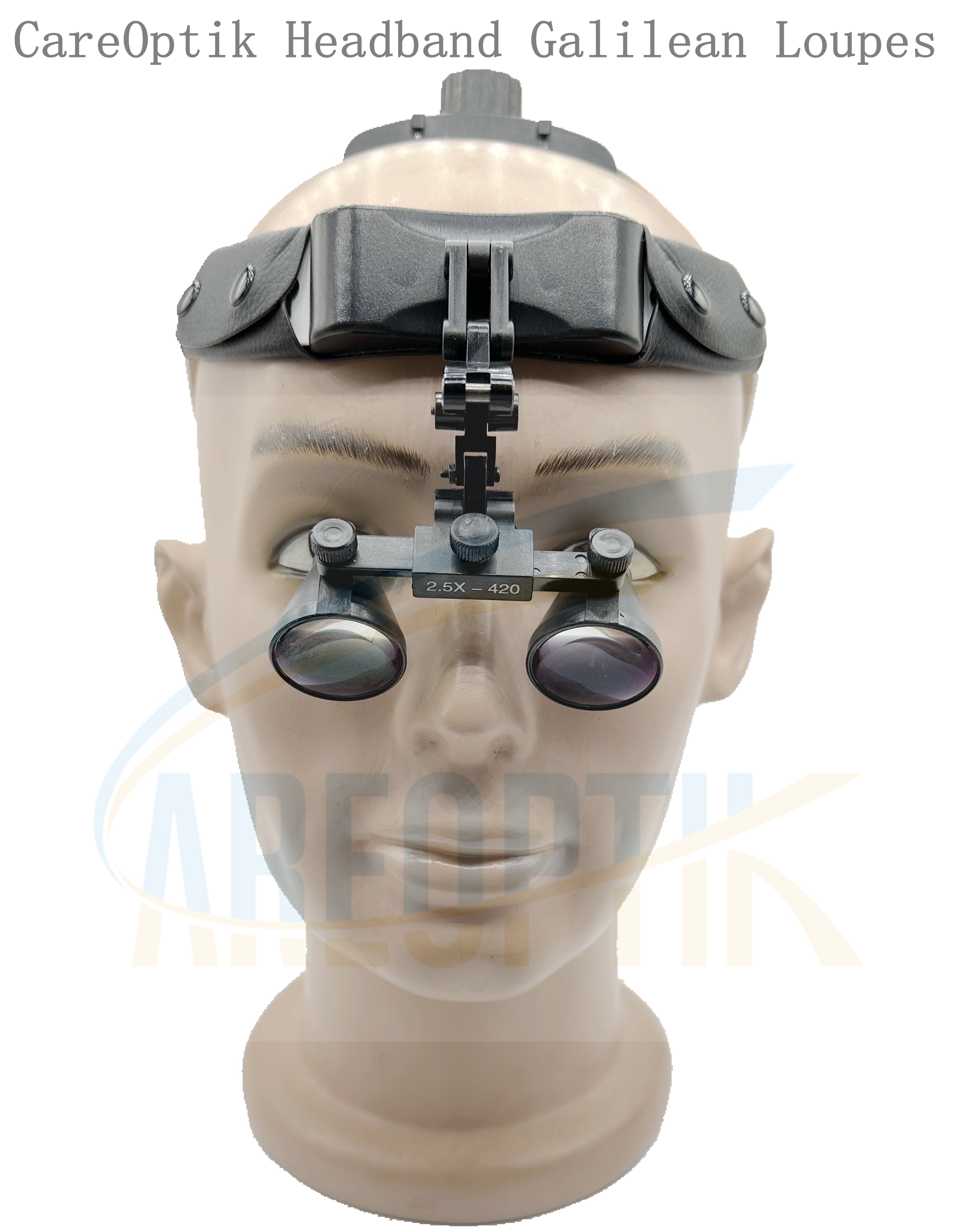
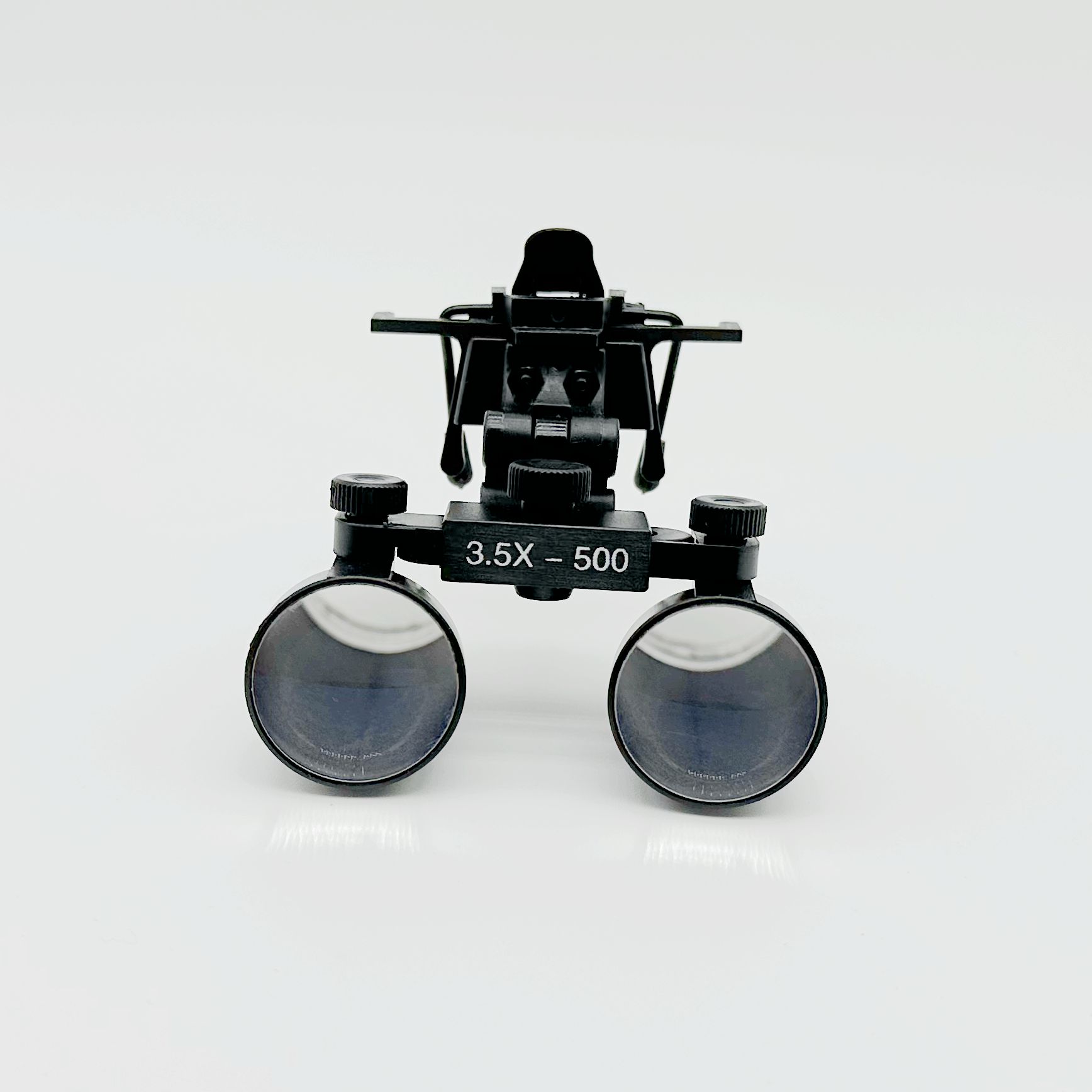
If you currently use flip-up loupes, note that the CHL-CX02 kit shown here is built around a TTL frame. Talk to us before assuming your existing flip-up glasses can be swapped in. That conversation is cheaper than a return.
Not a buying guide in the usual sense. Just the questions that come back to us most often:
Number four sounds trivial. It's the one that decides whether cordless feels effortless or annoying six months in.
Three groups, briefly.
If you need maximum output for hours at a stretch without thinking about power, a wired system or an overhead surgical light is still the safer choice. If you don't wear loupes and only want illumination, buy a headlight on its own. And if you were hoping for a universal clip-on lamp that moves between several pairs of glasses, this isn't that. It's a fitted system.
It's tempting to leave this out. We'd rather not: the wrong light for the job is a bad outcome for both sides.
Both, as sold. It's a TTL Galilean loupe with a cordless LED headlight mounted on the frame, supplied as a kit with batteries and a dock. It isn't a clip-on attachment for glasses you already own.
Three rechargeable packs and a two-slot charging dock. The third pack is there so you can keep working while two are on the dock.
Yes. That's what the flip-down amber filter is for. It reduces the blue-rich light reaching the working field while you handle composite. Flip it up when you want neutral white light again.
The kit shown here is built on a TTL frame. If you work with flip-up glasses, contact us with the frame details before ordering.
Charge all three packs beforehand and the rotation covers a normal clinic day. If "all day" means a single unbroken session with no chance to swap, a wired light is the more predictable option.
Microfibre cloth on the optics, a lightly damp cloth on the frame and battery housing. No soaking, no autoclave, no solvent on the lenses.
If you already wear loupes and the cable is the part you keep noticing, the CHL-CX02 is worth a closer look. If you've never thought about the cable, you probably don't need this.
The full specification, configuration options and kit contents are on the CHL-CX02 product page. If you want to talk through magnification, working distance or frame fit first, contact our team. Answering those questions before an order is easier than fixing them after one.