Loupes Manual: Provides detailed instructions for use and maintenance.
What is working distance, How to measure your Working Distance?
the working distance is one of the important data for the loupes. the working distance is the distance from the loupes user's eyes to the patient's mouth or the objects
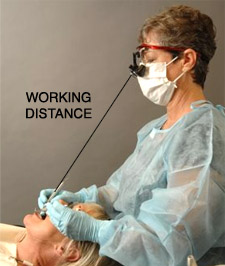
How do I measure my working distance?
working distance is the distance from your eyes to the objects operated when you working a normal position
While many things such as height, and personal preference should be considered, the easiest way to figure out your working distance is to:
Step 1- measure the distance from your eyes and the area you want to focus on (a mouth, an eye, etc), while sitting or standing in the correct ergonomic position, (back straight and arms perpendicular to the floor].
Step 2- Subtract 1.5" (the distance from your eye to the end of the Loupe
That number is your working distance:
Short (10"-13") 340mm
Regular 1 (14"-18") 420mm
Regular 2 (15''-19") 460mm
Long (17"-21") 500mm
X Long (22"-27") 550mm
just need to choose the closer one to your real working distance. because all the loupes have a depth of view. for examples. the loupe's working distance is 420mm. the real working distance is in the range: 360mm-460mm.
what is Pupil Distance? How to Measure Pupil Distance?
Pupillary Distance (PD) or interpupillary distance (IPD) is the distance (the industry standard is to measure in millimeters) between the centers of the pupils in each eye. This measurement is used when preparing to make prescription eyeglasses. Positioning lenses correctly in relation to the center of the pupils is especially important for higher-powered lenses due to the location of the optical center of the lenses. It can also be relevant to binoculars: they must be adjusted to suit the user's IPD, and the minimum allowed by some binoculars is still too great for people with a small IPD.
PD is measured either during the eye test or when prescription glasses are ordered. Obviously, we cannot measure your PD over the Internet, so it is best to make sure your PD is included in your glasses prescription.
If your prescription does not contain your PD:
- Ask to have it measured at an optical shop, some may charge a fee.
- Contact an optical shop where you have previously purchased prescription glasses. Your PD has been measured if you have ever had prescription glasses made up.
- Your previous optometrist may have a record of your PD.
- Alternatively, try measuring your own Pupillary Distance as explained below. (Note: Measuring your own PD may not be as accurate as having a trained person do it. If your head or the ruler moves during the measurement then the reading will be inaccurate)
The higher the lens power in the glasses prescription, the more important it is to use an accurate PD. These procedures may not work for everyone. We recommend that you obtain a professional measurement of PD whenever possible.
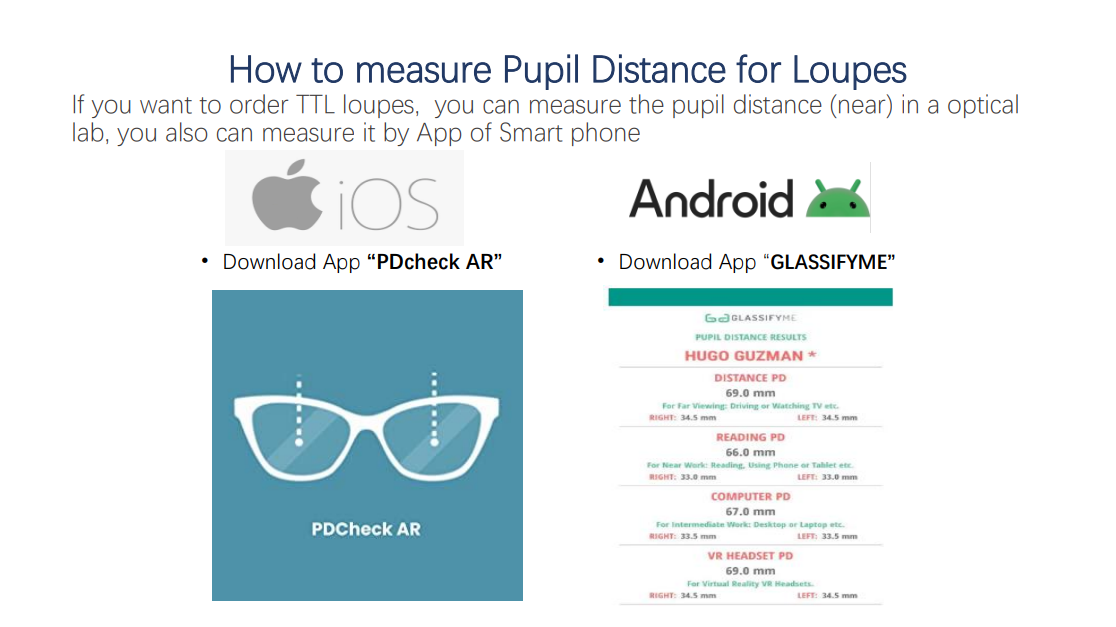
if you have no Pupil distance data, we suggest you can measure it at an optical lab, that is very easy, it just several minutes can get it.
if you want to measure your own PD, we also can guide you as below:
Measuring your own PD (Pupillary Distance):
using the Mobil Phone App to measure your PD. also will be fine.
Open your Mobil phone App Store, search " PDCHECK AR" And download this app. and then you can measure your PD with this App. notice. mounting TTL loupes need to fill near PD. So When you order, choose the PD with the same as the near PD you measured.